Why Brisbane: Setting Institutional Noir in a City That Seems to Have Nothing to Hide
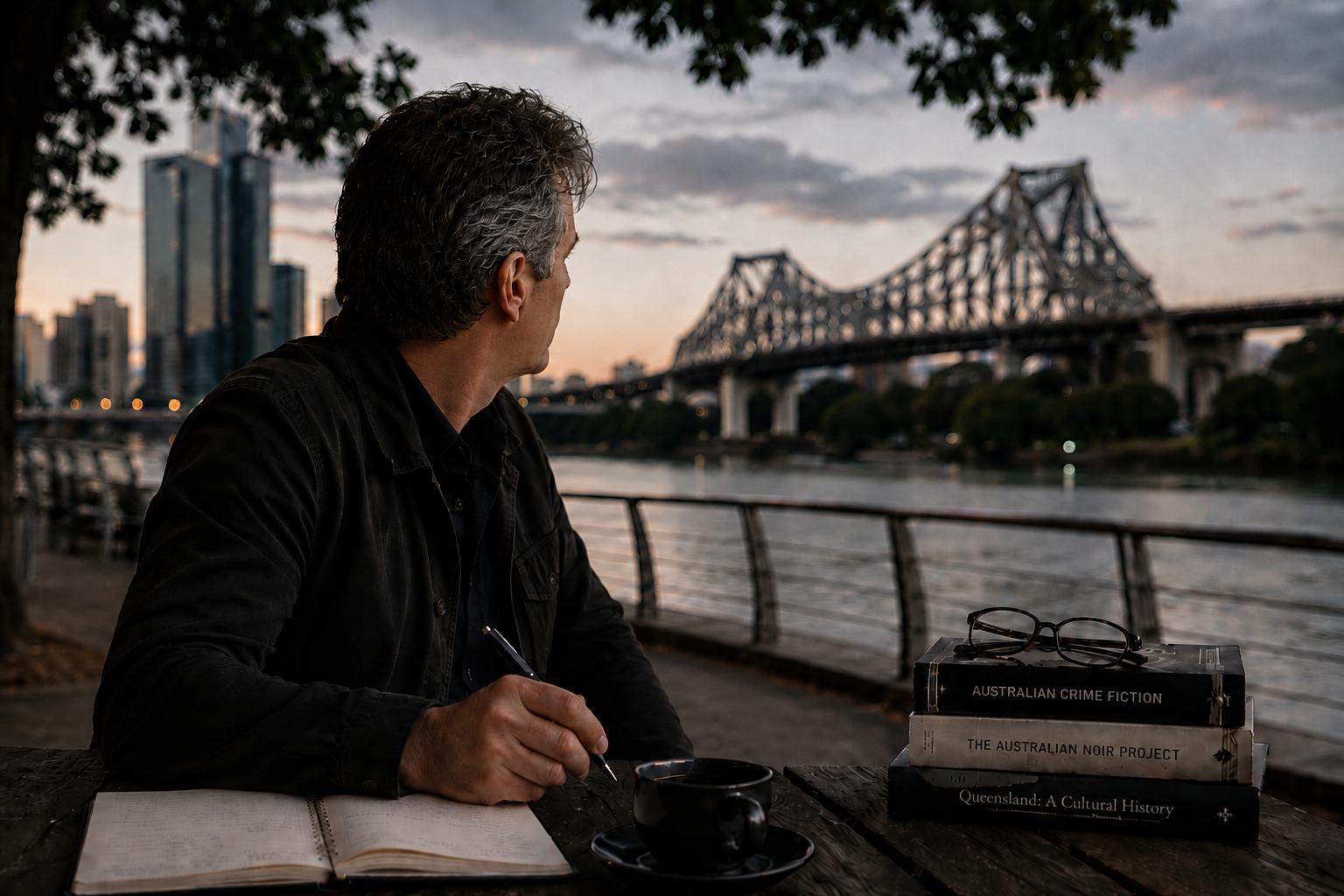
Brisbane is not the first city most people picture when they think of crime fiction. Sydney has its harbour and its underworld history. Melbourne has its laneways and its rain. Brisbane has jacarandas, humidity and a lingering reputation as a big country town that grew up quickly and politely.
That is exactly why I set the Detective Cassidy series here.
A city that looks calm
Under the Lilies opens on a university campus in December 2017. The lawns are trimmed, the paths are swept, and the lake holds the morning light without movement. Nothing about the place looks dangerous. Then a young woman is found beneath the water lilies.
The crimes in this series rarely announce themselves. They sit inside places that look orderly, well run and safe, and that appearance is part of what protects them. Brisbane is very good at looking calm.
The weather does a lot of that work. Summer here doesn't arrive dramatically. It builds, a steady increase in heat and moisture until even standing still feels like effort. Winter barely arrives at all, except in the shade, in basements and in tiled hospital corridors where the sun never reaches. I use both. The heat presses on people until something gives. The cool, hidden spaces are where things are kept out of sight.
Much of the series is rooted in Brisbane's inner west, where the river loops past campus grounds, leafy streets and old Queenslanders up on their stumps. Cassidy's Brisbane includes the Regatta Hotel, the grand old riverside pub on Coronation Drive at Toowong, where the city drinks, celebrates and occasionally says more than it should. And through all of it runs the Brisbane River: brown, slow and wide, carrying more than it shows.
Why 2017 to 2019
The series runs from late 2017 to 2019. By then Brisbane had been remaking itself for thirty years. Expo 88 put the city on the world stage, and the old exhibition grounds on the south bank of the river became parklands, galleries and a promenade where Brisbane goes to show its best face. In the late 2010s the change sped up again. Cranes stood over the city, new towers rose along the river, and the old government precinct was being rebuilt as a casino and resort.
Above it all, the Story Bridge, a steel cantilever opened in 1940, still carries the city's traffic across the river, lit up at night like a reminder of an older, more industrial Brisbane. That is the Brisbane of the books: a city polishing its image, where much of what matters is decided out of sight.
It was also a time when Australians were hearing, week after week, how large organisations could follow their own procedures, meet their own standards and still fail the people who depended on them. I didn't want to write about any real inquiry or any real organisation. But that atmosphere, the slow public realisation that harm can be compliant, sits behind every book.
The institutions in the novels are invented. Brisbane is not.
What I mean by institutional noir
Classic noir gives us a corrupt city, a compromised detective and crime as a kind of rot spreading through the streets. I've come to describe my own books as institutional noir. The rot is still there, but it isn't hidden in back rooms. It's written into procedures, risk assessments, committee minutes and acceptable limits.
In institutional noir, harm often happens lawfully, or close enough to it that no single person can be blamed. Warnings are recorded and filed. Complaints are absorbed by committees. Decisions make sense on paper and still leave someone dead. The series rests on one premise: when harm is lawful, someone still has to investigate.
Each book takes Detective John Cassidy and his partner, Detective Jenny Foster, into a different part of the system:
Under the Lilies: a university research laboratory built on pressure, ambition and silence
False Assurance: a hospital clinical trials unit where complications are reframed as “expected variation”
Terms and Conditions: reverse mortgages, broker incentives and internal bank approvals
The Acceptable Level: industrial contamination beneath a major Brisbane redevelopment
Unknown to Authorities: missing persons and the welfare and housing services meant to catch them
The settings change, but the question doesn't: what did people know, what did they write down, and what did they decide to do about it?
Cassidy is a detective trained to look for the person who made the decision that caused the harm. Increasingly, he finds there isn't one. That is the problem institutional noir sets its detectives, and it is a problem I find more unsettling than any villain.
The writers who shaped the series
I've learned from writers who take investigation and place seriously. Tana French showed me how much pressure procedural realism can carry, and how an investigation can be as much about the people inside it as the crime. Garry Disher and Jane Harper write Australian places that bear down on their characters, with a restraint I admire. Dervla McTiernan writes detectives working inside institutions as well as against criminals, and the cost of that.
I don't write like any of them, but I hope the series sits comfortably beside them on a reader's shelf.
Start the series
The Detective Cassidy series begins with Under the Lilies, a novella released on 9 December 2026. False Assurance, the first full-length novel, follows on 10 December. Each book is a standalone investigation, but reading in order lets you follow Cassidy and Foster as the consequences spread.
Read the opening of Under the Lilies, or sign up for news on future releases.

Comments